The Bus Shelter Syllabus: Pacing a Portfolio with Timetables and Request Stops
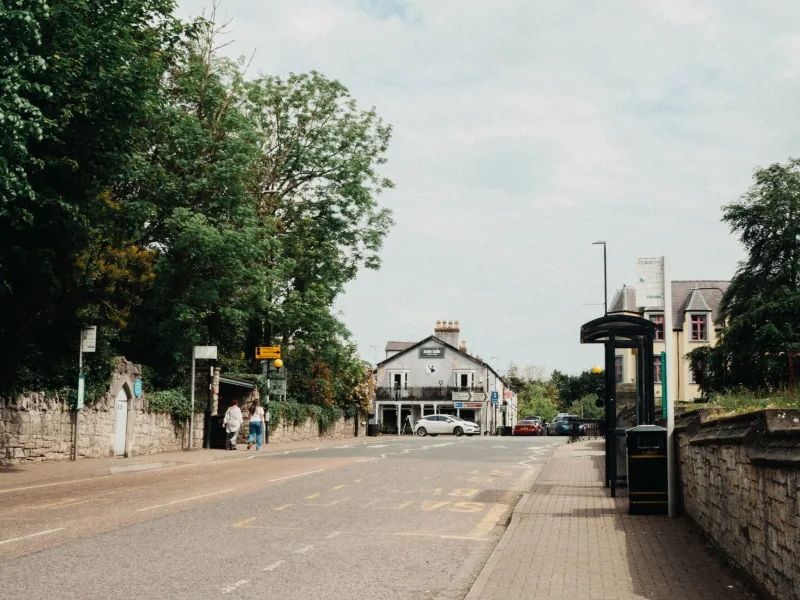
I missed the 09:12 by four minutes. Not dramatically — no sprinting, no shouting — just the quiet defeat of reaching the stop as the back of the bus disappears around a corner. The next one wasn't until 10:05, which gave me forty-three minutes to study a laminated timetable under a scratched perspex pane. It was, in hindsight, the most useful design tutorial I've had all month.
The plan had been simple: ride a provincial bus route from the market town out to a village, sketch a bit, come back. I'd packed a notebook, a pencil and the vague hope that a day away from the studio would shake something loose. What I didn't expect was a full portfolio critique delivered by a bus operator with a sense of humour and a clipboard.
The 10:05 to Somewhere
The bus arrived eight minutes late, which the driver described as 'not bad for a Tuesday.' I paid my fare, took a seat near the back and watched the town give way to hedgerows, gateways and the kind of wide grey sky that makes everything look like a watercolour left out in the rain.
What struck me first was how often we stopped. Not just at the marked shelters, but at the odd grass verge, outside a farm track, near a turning that didn't seem to lead anywhere in particular. Each stop had a reason, even if I couldn't see it. Someone got off. Someone got on. The bus waited. Then it moved again.
A portfolio, I thought, could learn from this. Too many of them — mine included — behave like a slideshow on a smooth motorway. Slide, slide, slide, done. Impressive, maybe, but oddly forgettable. The bus did the opposite. It stopped often enough that you noticed the journey.
Stops Are Structure
There's a tendency when assembling a portfolio to treat every image or project as a slide in a continuous reel. You pick the ten or twelve strongest pieces, put them in a rough order and hope the whole thing reads as a coherent body of work. It might, but it also might feel like a very fast train ride through a place you never quite see.
The bus route suggested something different: structure through stopping points. Not arbitrary pauses, but deliberate ones — a section opener, a quieter image, a change of pace. In a photographer's portfolio, that might be a single wide shot after a run of close-ups. For an illustrator, it could be a sketchbook page dropped between two polished finals. For a designer, a small text panel that says 'here's where this part begins' without shouting it.
The laminated timetable was the clue. It told me where I was, what was coming next and how long I'd be waiting. A good portfolio does the same, gently. It gives the viewer a sense of place and pace without over-explaining.
The Request Stop Problem
Halfway along the route, we passed a sign that said 'Request Stop.' The bus slowed but didn't stop until someone pressed the bell. It was a small thing, but it stayed with me.
Request stops are a bit like portfolio pieces that need a signal. They might be your quieter work — the personal project, the experimental series, the piece that doesn't immediately announce itself. They can be the most interesting things in the portfolio, but they need a small cue to tell the viewer they're worth pausing for. A caption. A title. A single line of context. Not a paragraph of explanation, just enough to say: this one is a stop, not a drive-by.
I've been guilty of leaving those pieces in with no signpost at all, hoping the work would speak for itself. Sometimes it does. Often it just gets skipped because the viewer is already looking for the next big thing.
Timetables and Captions
The bus had a timetable in a plastic wallet, a route map with faded colours and a hand-written notice about a diversion that had clearly been there since the previous spring. It wasn't elegant. It was useful.
Portfolio captions can be like that. They don't need to be beautiful prose. They need to do a job: orient the viewer, give a little context, maybe add a note of personality. A date, a place, a project name, a single sentence about why it exists. The kind of information that helps someone understand what they're looking at without feeling like they've been handed a manual.
The hand-written diversion notice was my favourite part. It was honest about the disruption. It didn't pretend the route was perfect. A portfolio doesn't have to hide its detours either. A note that says 'this series is ongoing' or 'this piece was a failure that taught me something' can be more engaging than a perfectly polished front.
The Long Way Round
At one point the bus took a loop through a housing estate that seemed to go nowhere near the main road. A woman in front of me sighed. The driver shrugged. 'Long way round,' he said, as if that explained everything.
It did, eventually. The loop picked up three more passengers and dropped off one. It added ten minutes to the journey. It also made the route feel like it belonged to the places it passed through, rather than just connecting two points on a map.
Portfolios can benefit from the long way round too. Not every project needs to be the most direct, most efficient version of itself. A series that meanders a little — that shows process, or context, or a change of mind — often feels more human than one that gets straight to the punchline. The trick is making sure the meander has a purpose. The bus loop wasn't random; it was serving people.
Getting Off
I got off at the village stop, walked to a bench near the church and drew for an hour. Then I caught the 14:40 back, which was late, as is traditional. The light was already going. The bus was warm. I felt like I'd been somewhere.
On the way home I wrote a short list in my notebook: stops, signals, timetables, detours, a clear sense of arrival. Not rules, exactly. More like cues. A portfolio isn't a bus route, but it is a journey someone else has to take with you. Give them a few places to pause. Tell them where they are. Let them see the long way round now and then.
And if they miss the first stop, make sure the next one is worth waiting for.